Muhammad Ossama: Lignin fragmentation and solubility in biorefineries
Aalto University
Lignin accounts for up to 30% of lignocellulosic biomass yet remains largely underutilized in current biorefineries, primarily because the phase behavior governing its solubility and fragmentation is poorly understood. This work presents a combined experimental and thermodynamic modeling study aimed at closing that gap. Solid–liquid and liquid–liquid equilibria are measured for lignin and its depolymerization products across industrially relevant solvent systems and temperature ranges.
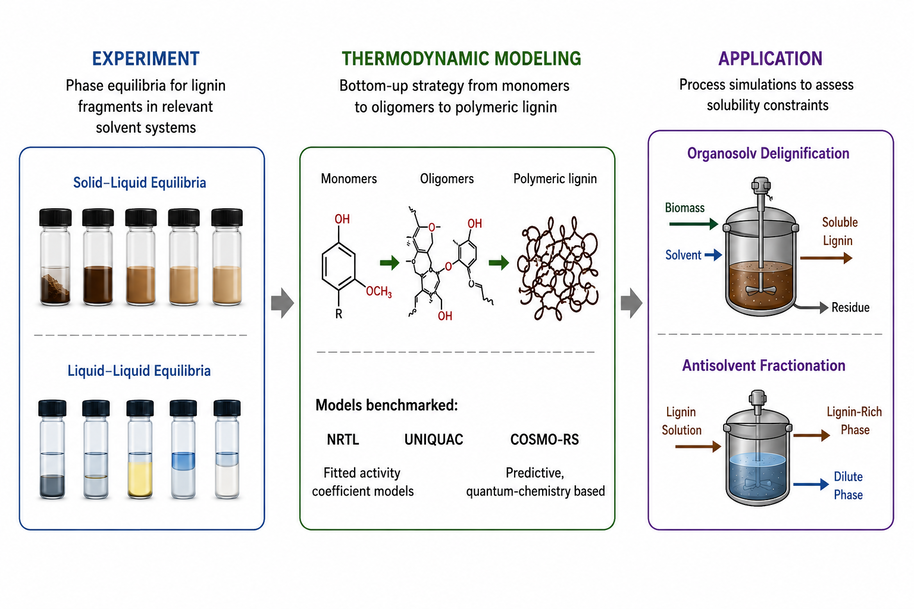
Modeling follows a bottom-up strategy: interaction parameters are first derived for well-defined phenolic monomers — guaiacol, syringol, vanillin, and ferulic acid — and progressively extended to oligomeric structures representing the dominant β-O-4, α-O-4, and 5-5 linkages, and ultimately to polymeric lignin. This approach assumes that macromolecular phase behavior can be reconstructed from fragment-level contributions, with explicit corrections for conformational flexibility and polydispersity. Three modeling frameworks are benchmarked: NRTL and UNIQUAC as fitted activity coefficient models, and COSMO-RS/COSMO-SAC as fully predictive quantum-chemistry-based methods requiring no experimental parametrization for individual solute–solvent pairs. The latter is especially suited to the broad chemical space of lignin fragments. Validated models are subsequently used in process simulation to assess how solubility constraints affect key operations including organosolv delignification and antisolvent fractionation. The results provide a quantitative thermodynamic foundation for model-guided lignin valorization process design.