Emily Hart: In Situ Functionalisation of Lyocell-Type Fibres
Aalto University
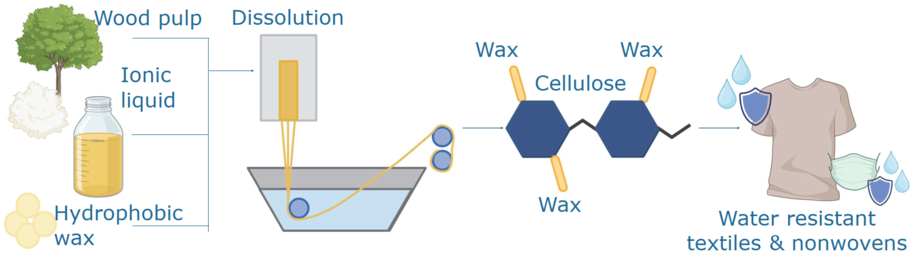
Man-made cellulosic fibres are an environmentally friendly alternative to synthetic textile fibres like polyester, but they are limited by their high water absorbency. Current water-repelling treatments use chemicals, such as PFAS, that can be harmful to the environment and human health and are facing restrictions and bans worldwide. The treatments are typically applied on the surface of fabrics often leading to poor durability during washing. A potential improvement is the incorporation of non-toxic hydrophobising agents already during fibre production, integrating the chemical within the fibre structure. In this project, alkyl ketene dimer (AKD) wax is added in situ into a cellulosic spinning solution prior to spinning into fibres using dry-jet wet spinning.
AKD is a hydrophobic wax widely used in the paper industry since the 1950s. It is applied as a sizing agent to control the wettability of paper and board products by making cellulose fibres more hydrophobic. The addition of AKD allows fibre spinning at similar conditions as a solution without wax, and the resulting fibres exhibit increased hydrophobicity compared to reference fibres. The addition of the wax leads to a small reduction of the mechanical properties of the fibres but can still retain higher tenacity and elongation than some commercially available fibres such as cotton. The resulting fibres could potentially be used in production of various water-repelling textiles or nonwovens.
Adding the hydrophobising agent during the fibre formation step would eliminate the need for hydrophobising post-treatment of fabrics, requiring less time, energy, and chemicals. Furthermore, introducing hydrophobicity already at the fibre-level could lead to a more durable treatment, as the hydrophobic agent is embedded inside the fibres as opposed to solely on the surface of fabrics. This would prolong the life of water-repellent textile products, decreasing their environmental impact.