Bigyan Dahal: Modifications of biopolymer membranes for enhanced separation performance in biorefining applications
LUT University
In lignocellulosic biorefineries, wood‑based process streams contain valuable compounds such as hemicelluloses, lignin, sugars, organic acids, and phenolics. The efficient separation and recovery of these compounds to use as raw materials for fuels, chemicals, and high‑value biomaterials remain technologically challenging. The complexity and variability of biomass compositions further complicate the separation processes. In this context, membrane technology has emerged as a promising separation method due to its operational simplicity, high separation efficiency, and low chemical and energy demand. For example, pressure‑driven ultrafiltration and nanofiltration processes are of interest for the recovery of hemicelluloses from wood hydrolysates and lignin from spent liquors in pulp mills. However, fouling remains a restrictive feature of membrane technology. Despite regular cleaning, membranes gradually lose their separation capability over time and eventually reach end‑of‑life status, requiring replacement.
The future of membrane technology is increasingly directed toward sustainable and fouling‑resistant bio‑based membrane materials. Cellulose is particularly attractive biopolymer for this purpose due to its renewable, biodegradable, and hydrophilic attributes. Compared with petroleum‑derived polymeric membranes, cellulose‑based membranes typically exhibit lower fouling tendency due to the inherent hydrophilicity of cellulose. However, commercially available cellulosic membranes are still limited by their standard molecular cut‑off range for selective fractionation of target biomass components. In addition, native cellulose is prone to hydrolytic damage under extreme pH conditions.
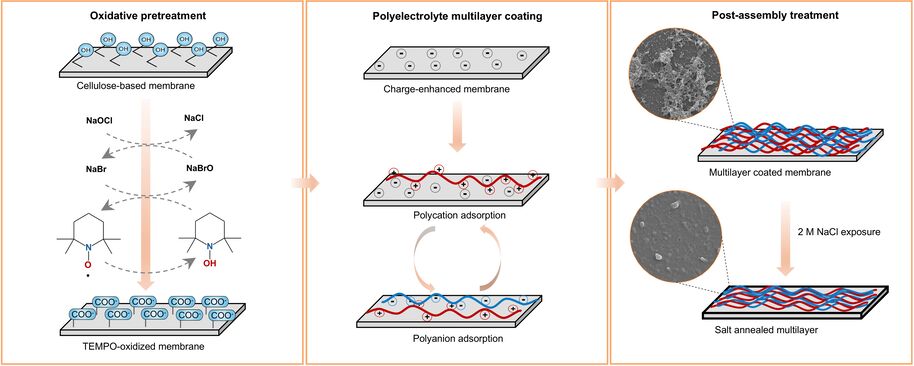
Surface modification offers a practical strategy to improve the properties and performance of cellulose‑based membranes without fundamentally compromising the characteristic benefits of the bulk material. The hydroxyl‑rich structure of cellulose provides various modification routes to impart desired functionalities. TEMPO‑mediated oxidation, for example, is an effective approach to increase negative surface charge of cellulose with minimal structural degradation. The oxidized cellulose surface is an ideal charge‑enhanced support for layer‑by‑layer deposition of polyelectrolytes. The charge‑adhered polyelectrolyte multilayer deposition is a versatile and tunable technique to form ultrathin coating with controlled permeability, selectivity, and surface characteristics. For instance, multilayer coating can be applied on a rather porous membrane support to tailor its pore‑size, surface charge, and morphology to achieve specific separation requirements. Additional post‑treatment methods, such as salt annealing and chemical crosslinking, can further improve the multilayer stability and separation performance.
The primary objective of this research is to explore modification strategies to develop low‑fouling, selective, and high‑performance biopolymer membranes for biorefining applications. The research therefore focuses on modifications of cellulose‑based membranes through oxidative pretreatment, polyelectrolyte multilayer coatings, and post‑treatment methods. The research aims to contribute to the development of sustainable membrane systems that support the transition toward a circular bioeconomy.